
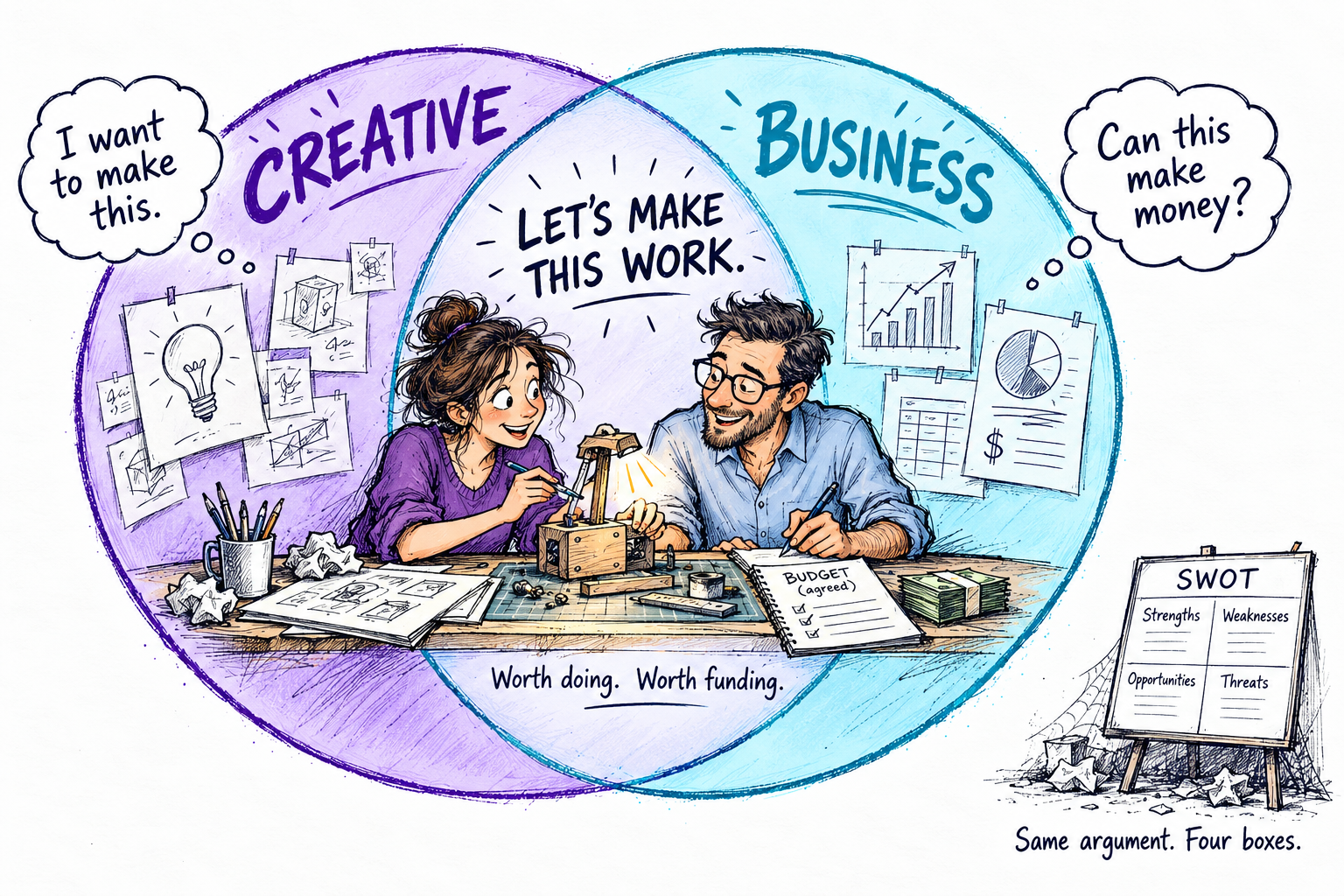
The sweet spot:
when both sides want to do the work
The creative person starts with “I want to make this.” The business person starts with “Can this make money?” Both are useful questions. The interesting part is what happens when they swap seats halfway through the project.
The motivations move. The job titles don’t.
Creative and financial priorities rarely stay in their original order. The person drawn in by the work eventually needs to know when they get paid. The person drawn in by the return can become thoroughly absorbed in what the team is building.
Six weeks ago, the creative person was defending the idea and the business person was questioning the cost. Now the business person is defending the potential and the creative person is questioning the payment schedule. They’ve learned to appreciate each other’s position. Just not at the same time.
Worth doing. Worth funding.
The sweet spot is shared commitment to the work, supported by financial terms both sides can trust. The money is already coming in, or there is a credible, agreed way for it to come in. That gives people room to care about making something great.
Agree on what you are making, why someone will value it, what it costs, and when people get paid. Then the budget can support the project instead of auditioning for the lead role.

When money takes over the conversation
Money deserves attention. An unpaid invoice is remarkably good at becoming the most interesting thing in the room. The disconnect starts when protecting payment, margin, or a forecast becomes the whole purpose of the conversation, and the work becomes something everyone is negotiating around.
A creative team cannot pay rent with enthusiasm. A business cannot fund every idea on the grounds that it feels promising. Put the financial questions on the table early enough to answer them together. “We’ll sort it out later” is an excellent way to schedule the same disagreement at a higher cost.

Intangible assets. Real business value.
Creative judgment often recognizes value before a spreadsheet can describe it: an idea that feels unmistakably yours, a story people believe, or a team that knows how to turn a rough thought into work that connects. The financial person may recognize it too. Recognizing it and assigning it a defensible number are different jobs.
Those intangible assets live inside the company as well as outside it. Original ideas, accumulated know-how, shared judgment, and trust between colleagues shape what the business can create. Brand recognition, reputation, and customer relationships shape how that work is received. They are real sources of value, even when the spreadsheet has yet to offer them accommodation.
Bring both perspectives to the assessment: what value are we building, how does it help the business, and what evidence would show it is growing? A useful financial model makes room for judgment. A useful creative argument gives that judgment something concrete to stand on.
Same argument. Four boxes.
Your creativity is a Strength until you ask for the budget. Then it becomes a Weakness. The project is an Opportunity until somebody questions the forecast. That person is now a Threat.
The SWOT analysis is complete. Nobody has changed their mind, but everyone has a designated parking space.
Four boxes can organize a discussion. They cannot tell you whether the people in it still want the same thing. That requires a conversation, inconveniently without a template.
Get excited about the same thing.
The aim is work both sides want to make happen, with economics both sides understand. Creative insight helps identify what is worth building. Financial judgment helps make it possible to keep building it. That is the sweet spot: a great project with a business behind it, and a business with something worth getting out of bed for.